Wednesday, November 2, 2011

A woman's shadow work is never done


Speaking of paid and unpaid work, the New York Times just ran a fascinating op-ed piece by Craig Lambert, deputy editor of Harvard Magazine, about “shadow work.” That’s a term Lambert says was coined 30 years ago by Australian philosopher Ivan Illich to describe all of the work people do that they don’t get paid for, such as housework, shopping, paying bills, etc.


Lambert argues that machines, instead of liberating us from repetitive and menial tasks, have actually increased the amount of shadow work we do. We pump our own gas, squeegee our own windows, bag our own groceries, plan and book our own travel arrangements. Chores that we now perform for ourselves, often with the help of technology, were once done by human beings who got paid for it. At our jobs, support staff  like secretaries and clerks have been reduced, their tasks—typing, copying, mailing, sorting email—added to remaining employees’ other responsibilities. “Even those in senior management perform these humdrum jobs,” Lambert writes.


Doctors say patients complain of fatigue, Lambert notes. “Much of this fatigue may result from the steady, surreptitious accumulation of shadow work in modern life,” he writes. “People are simply doing a huge number of tasks that were once done for them by others.”


I’ll leave it to economists to figure out whether Lambert is right, whether technology has produced a net increase or decrease in shadow work. Obviously, technology has streamlined many unpaid tasks: washing dishes, looking up information, shopping for certain items.


What most interests me is the timely point tucked within Lambert’s piece. More people are questioning, thanks in part to the Occupy Wall Street movement, why so many Americans are struggling while a tiny minority rakes in phenomenal wealth.

Lambert’s thesis provides one explanation for that phenomenon. But he steers around that point, blaming not CEOs but the machines themselves. “The robots have won,” he announces. “The robots are in charge now, pushing a thousand routine tasks onto each of our backs.”


But of course, robots aren’t the ones forcing humans to do extra work. Robots, who will gladly work for free, don’t benefit from the arrangement. Robots aren’t lighting cigars with $100 bills. That would be, at least theoretically, the people who profit from the robots’ work. Of course, not all business owners are thriving financially, not even those who have replaced employees with machines. But whatever financial savings are being seen—in salaries, health insurance and so on—isn’t going to the machines, let alone the people taking on extra shadow work.


Meanwhile, there’s one important category of shadow work that Lambert doesn’t mention at all—understandably, since it’s not central to his point—but that is relevant to this blog: caregiving. Technology, as far as I can tell, neither dramatically reduces nor increases the work of caring for children, the old and the sick. But some research indicates that parents, especially mothers, are spending more time than ever on childcare.


As the New York Times reported last year:

Before 1995, mothers spent an average of about 12 hours a week attending to the needs of their children. By 2007, that number had risen to 21.2 hours a week for college-educated women and 15.9 hours for those with less education.

Although mothers still do most of the parenting, fathers also registered striking gains: to 9.6 hours a week for college-educated men, more than double the pre-1995 rate of 4.5 hours; and to 6.8 hours for other men, up from 3.7, according to an additional analysis by Betsey Stevenson and Dan Sacks, economists at the Wharton School of the University of Pennsylvania.


It stands to reason that, as our population ages, we’ll be spending more time caring for our elders, too.

Unpaid caregiving represents a big chunk of shadow work, and it still falls disproportionately on women. If Lambert is right, it helps explain why we’re feeling so overwhelmed. We’re juggling paid work, plus more of the traditional shadow work than we performed in the past, plus new high-tech forms of shadow work.

Now, if you’ll excuse me, I have some shadow work to do in the kitchen.


Friday, October 28, 2011

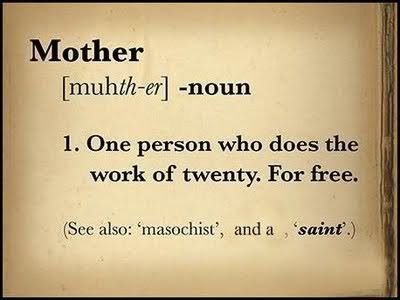
Why I don't "like" the idea that mothers do the work of twenty, for free


I saw this image posted the other day on the Facebook page of a social networking site for mothers. When I last checked a moment ago, the picture had been shared 2,920 times (including by a friend of mine, whose status update is where I first saw it) and “liked” 3,742 times on this mothers’ site page alone.

I didn’t share the post. I did not “like” it. I didn’t even like it.

Which made me more or less alone among the 700-some people who left comments. I haven’t read every last one, but in a quick skim I didn't see any other commenter who wasn’t delighted with the sentiment expressed in the post. Typical comments—short and hastily typed, as if clicked out between laundry loads, or while waiting that cry from the nursery signaling naptime had ended—said things like “True!” and “Sharing,” and  “Ain’t this the truth,” and “AMEN,” and “Sounds about right” and “Us mums are incredible :)” and “LOVE LOVE LOVE this.”

Not to be a buzz kill. But this approving reaction goes a long way toward explaining why mothers’ labor gets exploited, why mothers, far from being financially compensated for their parenting work, are in fact financially penalized for performing it, to their eventual economic peril.

Oh, that's OK, the comments suggest. We don’t mind! Our children are so important to us. We’re happy to do it! We LOVE LOVE LOVE doing it!


Lots of people love their work. Yet many of them are nevertheless rewarded for it monetarily, sometimes handsomely. (At least writers, who also often wind up working for free because the market exploits their love of the work, complain about it.) Posts like this—simply the new-technology delivery of an age-old sentiment—are one way society reinforces the idea that good mothers don't mind sacrificing. That good mothers are proud of sacrificing.
The post isn’t quite accurate; even the most hardworking mothers don’t do the work of more than two or three people, tops. And not even that on average, according to a cover story in Time magazine in August, which reported that new research shows mothers work about the same amount as fathers—as long as you count both paid and non-paid work, since mothers unsurprisingly do proportionately more of the latter than fathers do.

“ What these new findings mean is that the widespread belief that working mothers have it the worst—a belief that engenders an enormous amount of conflict between spouses—is simply not the open-and-shut case it once was,” wrote Ruth Davis Konigsberg. “… And it's time that women — myself included — admit it and move on.”

Again, I must differ. Unless by “move on” Konigsberg means “turn our attention from who works more hours to focus on what is really the far bigger issue—i.e., the fact that many more of those oh-so-equal hours that fathers put in are rewarded with paychecks. Not to mention retirement accounts, professional advancement, earning power, social status, health and dental, the respect of future employers and the occasional company car.”

Whereas mothers, as even the disliked post above correctly notes, work for free much of the time.

Konigsberg doesn’t dwell on the pay thing. On the contrary, she barely mentions it, writing as if the issue of monetary compensation were a triviality, as if paid and unpaid work were, for all practical purposes, the same thing; work is work.

I, on the other hand, consider a paycheck a salient difference, if for no other reason because even when it's shared between partners, the partner whose name is on the checks is building a much stronger foundation of future employability.
Frustrating as it is to see that overlooked in a Time cover story, it's better than the other, far more widespread attitude: that paid and unpaid work are completely different. So different, in fact, that unpaid work actually isn’t work at all.

Mothers’ caregiving work doesn’t count for the purpose of acquiring health insurance or 401(k) contributions or Social Security credit. Mothers’ work doesn’t count even if their labor—washing diapers, meeting with teachers, driving to dental appointments, coaching with homework, preparing meals—frees the other parent to devote more time to work that does earn a paycheck and therefore does count. (To avoid being labeled sexist, let me note that the genders are occasionally reversed.)

Sure, by now anybody with a speck of cultural sensitivity is careful to use the PC terminology, to delicately distinguish between work “outside the home” and “in the home.” But that's one of the rare times when mothers’ caregiving work is treated like, well, work.

Mothers who “opt out” to care for their children are considered to have stopped working. If they later try to find a paid job, they worry about how to explain “the gap in their resume” as if having to rationalize a time when they weren’t working. I have talked to women who've been told they would be better off padding that gap with a minimum-wage, part-time, unskilled job than admitting to potential employers that they were at-home mothers.

This attitude helps explain why, even when they're getting paid and working in comparable jobs, mothers make less money than non-mothers (including fathers and childless people of either sex). It helps explain why more women than men are poor. It helps explain why so little status is attached to mothering, why at-home mothers often mention experiencing the “cocktail party demotion” in which they see people’s eyes, when they mention their occupation, dart around the room in search of better conversation, as if a (working) accountant or engineer is automatically better at exchanging sparkling repartee over the martinis.

It helps explain why, when I divorced and thereby lost my health insurance, I wasn’t eligible for the federal government program that, because of the bad economy, subsidized about two thirds of COBRA premiums for laid-off workers. Even though it was just as tough for me to find a job or afford COBRA (about $500 a month, in my case).

I may not have been doing the work of twenty people. But in the federal government's eyes, I wasn't even doing the work of one.

So am I suggesting that someone should start paying mothers a salary for taking care of their own children? Well, that's hard to envision, certainly in the current political climate. But folks, let's start considering it real work that deserves the respect and some of the economic protections and social benefits we give to other kinds of work. Either that, or let's insist that mothers and fathers share the work of parenting more equitablythat both, let's say, do the work of ten people.

Until then, damned if I'm going to “like” a post comparing me to a masochist and a saint. I have no interest in earning either label.

Here’s what I wrote in the comments:

True or not, celebrating this sort of slogan reinforces the idea that it's OK. Mothers should not be expected to do the work of 20 people for free. The work of raising children should be shared among fathers and the rest of the village, and mothers should not have to sacrifice their financial security to see that it gets done.

Four people clicked “like” on my comment.

Then the posted comments returned to “True!” and “Awesome!” and “Yup, spot on."

Thursday, October 13, 2011

What we talk about when we talk about parenthood

Rebecca Odes has written an excellent post on Babble's "Strollerderby" blog about discussing parental ambivalence with non-parents. And I say that not because she agrees with me.

Well OK, that is a big part of the reason. But also because Odes explains the phenomenon really well, and makes several additional good points.

Such as:
Yes, parenthood is hard sometimes. But really, so are a lot of things that bring rewards.  You don’t have to tell a parent about the rewarding part; a parent is living it. But the feelings of joy and fulfillment that come from raising a child are hard to describe or to express. Partially, perhaps, because people feel bad about expressing them,  because everyone knows that non-parents don’t want to hear you get all googly eyed over your kid. People complain when parents complain, but they complain about parents kvelling, too.
It seems like non-parents mostly want parents to just shut up already.
Excellent observation. The XX Factor post I mentioned a few posts ago that criticized mothers' complaints was also put off by their "bizarre baby proselytizing." My impression is that people who don't want to hear you gripe about parenting really really don't want to hear you go on about what a joyful experience it is.

And you know what? I get this. Before I became a parent, I didn't particularly want to go into a lot of conversational detail about either one, either. Any more than I want to hear, say, a runner friend go on and on about his or her pacing and hydration and electrolytes and whatever. At least not more than maybe once.

Which is why, when I talk to my non-parent friends, I tend to discuss other subjects. Which is fine! Because believe it or not, I'm interested in many other subjects, including but not limited to the weather, work, food, books, movies, travel, current events, the economy, politics, fashion, politics, religion, writing, shopping, funny things we saw on the internet.

(And I would rather discuss just about any other subject, really, than what my children are up to lately with a non-parent friend who asks in a sort of polite, perfunctory, obligatory way, as if secretly thinking, "I know her life revolves entirely around them and she probably has no interest in talking about anything else, so here goes ..." Which, by the way, in my observation seems to happen less to fathers than mothers.)

When parents are talking to each other, though, their kids are sort of an natural area of conversational commonality. And if there's a non-parent or two in the room at the time, I don't think parents are required to show only the good parts in order to soothe or cajole or trick them into making the same choice. Or as Odes puts it:
Acknowledging the difficulties should me a way for parents to find support, both personally and culturally.  But even if it’s not, I don’t think parents should have to be their own marketing department.  As far as I’m concerned, my evolutionary imperative does not extend to the species at large.

Right? Most people don't, or at least shouldn't, care whether someone else chooses to have kids or not. (Except maybe because we want lots of workers paying taxes at the point when we're collecting Social Security.) Anybody else, as far as I'm concerned, is free to do whatever they want.
And somehow it usually all works out. My non-parent friends, like my parent friends, seem quite happy with the paths they've taken.


Tuesday, September 27, 2011

Great reading in the new Brain, Child

As promised, here is my article/essay (essicle? artay?) in the new issue of Brain, Child magazine about mothers who complain, and the people who complain about mothers who complain.

Also, check out Brain, Child's table of contents for a couple of really excellent essays. Sarah Werthan Buttenwieser writes about open adoption and her complicated relationship with her daughter's birthmother. Tracy Lynch explores what we mean when we call something "inappropriate," and wonders whether we could all stand to stretch our boundaries a bit.

And of course, check out the whole paper issue of Brain, Child itself to read lots of honest and intelligent writing about motherhood. It's a magazine in which, if you complain about motherhood, people won't roll their eyes. And if you talk about how wonderful motherhood is, they won't give you that pat frozen smile and try to be subtle as they gaze around the cocktail party in search of more interesting conversation.


Sunday, September 18, 2011

Trying to explain the paradox of parental happiness

Irin Carmon of Jezebel has written an account of the same screening of the new movie I Don't Know How She Does It—and its Q&A session afterward with star Sarah Jessica Parker and novelist Allison Pearson—that was reported in a Slate post that I wrote about a couple of days ago. Like Slate's Jessica Grose, Carmon compares the event to a group-therapy session, though thankfully she avoids sneering at the other women in attendance.


Also like Grose, Carmon worries that movies like IDKHSDI—and comments by mothers at the screening—make motherhood seem, well, awful (frankly, the movie itself sounds pretty awful, but that's a matter for another post). Carmon writes, as Grose also implied, that hearing about all these problems is a turnoff for young women like themselves, who don’t have kids yet.

Childless young women don't necessarily welcome a bunch of negativity, I’ve come to realize in writing about this issue here on the blog and in an upcoming piece for Brain, Child (link to come, once it runs). They’d rather anticipate motherhood as joyful. Make it sound like a bummer, Caron and Grose suggest, and they’ll want to skip the whole thing.


"So I'm curious how do you balance being really honest about the fact that it's really challenging, with scaring younger women?" Carmon asked the celebrities, during her turn at the mic.


Parker, Pearson and some woman in the audience tried to explain that, however much it sometimes sucks, parenting overall is nonetheless wonderful.

Parker and Pearson discuss "I Don't Know How She Does It."
Honestly, it’s no wonder Carmon and Grose were dismayed.

The hassle/happiness balance of parenting is unquestionably a paradox, one that’s tough to discuss even with another parent who totally gets it, let alone someone who hasn’t experienced it. Just last night, in a conversation in Real Life®, a friend and I were exchanging motherly rants about how our children drive us nuts. We noted that our childless friends lead more serene existences—they get to choose what to do after work, don't have to clean up after anybody but themselves, never are nagged to buy stuff they can't afford, never (or at least rarely) have to helplessly endure the wrath of planeloads of strangers. Yet we also agreed that, despite everything, we’re still glad we have kids. Not only because we love our specific kids, but also because it’s an experience we wouldn’t want to have missed.


But why? Here we grasped for the right words. Because it’s, um, a challenge? Because kids make life unpredictable and variable? Because what doesn’t kill you makes you stronger? Yes, sure, all of those things.


Except that those don't sound all that fun, either.


What parents feel, I think, is not reducible to simple concepts like “happy” or “fun.” Those words are vague enough themselves, let alone when you try to stretch them to cover an experience that, let’s face it, involves its share of heartbreak, worry and swearing. Hence the bewilderment, not only of Carmon and Grose, but of journalists trying to explain all those studies finding that parents are less happy than non-parents.


Maybe satisfaction in parenting is a primitive animal reflex, hardwired in our brains by evolution, enhanced with washes of hormones. Maybe it's some other mysterious emotion entirely, one that exists independently of those modern comforts we usually associate with enjoyable lifestyles—concepts like “plenty of free time” or “adequate sleep." Or maybe, speculates the Atlantic’s Megan McArdle, “we are simply sentimentalizing the whole ordeal to keep ourselves from rooting out our unused passports from the sock drawer and dashing off to Europe, never to be heard from again.”


In any case, try to describe any of this to people who haven’t experienced it and you may sound inane. You may even find your efforts described on someone’s blog as “bizarre baby proselytizing.”


One more thing puzzles me about this episode. Why should anyone care whether Carmon and Grose want kids—or whether they’re driven instead, as Grose suggests, to “consider sterilization”? That is, aside from whatever larger, demographic concerns we might have about building a sufficient work force to subsidize our future Social Security and health-care requirements.


Personally, I’m not desperate enough to sugarcoat things with an eye toward securing my monthly checks. And there’s no point in snaring women into parenthood with false promises of paradise, like 19th century land speculators luring unwitting Easterners west to what turned out to be harsh prairie homesteads.

I say we lay out the realities for not-yet mothers as honestly as possible, then leave it up to them. Having children is an act of faith, its consequences unpredictable. If they have kids, most likely, they’ll be glad they did it, despite the challenges. If they don't, most likely, they'll be content also.


If young women like Carmon and Grose think the risk of dissatisfaction is too great, as far as I'm concerned they should feel free to skip the whole thing.

Friday, September 16, 2011

Why even mothers with beachy hair might have a point

I have pulled myself out of blogging hiatus and its accompanying guilt spiral to discuss this post on Slate's "XX Factor" blog, in which Jessica Grose reports on a special screening of the new working-mother comedy I Don't Know How She Does It. The event included a post-viewing Q&A with star Sarah Jessica Parker and Allison Pearson, author of the best-selling novel on which the film is based. Grose writes that she was so unnerved by the mothers in the audience—their post-viewing questions turned the event into something resembling a 1970s-style "group therapy session/modern consciousness raising circle"—that she fled before she was forced to "consider sterilization" (Grose has no kids, but apparently intends to someday).

Sarah Jessica Parker and Allison Pearson speak at the screening.


For what it's worth, I haven't seen the movie (and didn't finish the book). Judging from the trailer, it doesn't look very good, and I suspect my own reaction will resemble Mary Elizabeth Williams' review on Salon. But that's probably beside the point here.

I have an essayish article coming up in the fall issue of Brain, Child (I'll link to the actual piece once it goes online) about the phenomenon of feminist, progressive writers—people you’d normally expect to support women's choices and viewpoints—turning critical and contemptuous when the women in question happen to be mothers expressing some discontent with their lives. Surprisingly often, writers trivialize mothers' complaints, casting them as excessive or overwrought or whiny or merely First World problems of privileged women.

My essay offers a handful of illustrations (including, sad to say, a couple from "XX Factor"). Grose's blog post, having just appeared yesterday, long after my deadline, isn't one of them. But it could be.

Let me interject that I respect Grose as a writer. And that we've all been in groups whose aesthetics, opinions and so forth didn't match our own. And that it's possible there's something she's trying to convey in the post—some truly eye-roll-inducing aspect of the event she attended—that I'm just not grasping.

But. Come on.

... (T)he crowd did not look much like journalists: It was almost exclusively women (I counted two men), and almost all of them had the perfectly set "beachy" waves that are meant to look tousled but clearly took at least an hour with a curling iron and various products to create. When the heavily made-up moderators (one in fetching leather pants) got on stage to announce the movie, I realized that this was an event for mom bloggers ...

Could we feminists agree to avoid pointing to the scarcity of men at an event to implicitly undermine the event's seriousness (when the real reason might have to do with the nature of the event itself, or possibly even with men's obliviousness to a legitimate issue)? Could we, further, declare a moratorium on discrediting what women say based on their hairstyles, makeup and clothing? Is it really all that odd for women to spend some time on their appearance before sitting on a stage next to celebrities, including one who is famous for her stylishness? Please bear in mind that I am a person who has never owned leather pants and whose hair would only be described as "beachy" not in the “curling iron and products” sense but in the "she obviously spent all day at the kids' swimming lessons and hasn't been near a comb since" sense.

Grose's description of the session is laced with implicit contempt. The woman introducing SJP "squealed with delight." The moderators' questions were "somewhat coherent." Audience members engaged in "bizarre baby proselytizing" and spoke of their lives in a "groovy '70s emotional mode." The actress and writer "did their best to relate to the women, to soothe them" (not, Grose suggests, because the stars genuinely empathized or agreed, but because SJP has good people skills).

As she listened, Grose found herself "saddened" because the attendees "were clearly in need of some outlet for their discontent." And because the poor things were deluded enough to think they'd find "a satisfying answer" from ... well, an actress who starred in a movie on the subject and frequently publicly discusses her own family life, and an author who wrote a whole book about it and has undoubtedly talked to thousands of mothers since then.

As for the attendees’ actual statements, I have read through Grose's post numerous times and still can't for the life of me figure out what she found so ridiculous or out of place about them. A stay-at-home mother of five said she often feels trapped and envious of working friends (and vice versa). Another woman feels guilty about leaving her son with his grandmother rather than taking him to play dates. Another is annoyed at friends who wanted to bring their children along on a group trip.

These are individual predicaments, but they touch on some of the very real problems that many mothers experience: isolation, envy, guilt, the often-thwarted need for respite.

Instead of making fun of these squealing women in their overdetermined hair and makeup, I think it makes sense to consider the extent to which their feelings might be shared by many other contemporary mothers, including those with suitably unstyled hair and pants made of cloth, and to wonder whether these potentially widespread problems just might be of interest from a feminist perspective.

Take the at-home mother who feels trapped. One wonders whether 21st century mothers are particularly subject to this sort of isolation, restlessness and envy, as well as to cultural pressures that would lead an intellectually active woman to choose staying home over a career in the first place. Might there be structural and institutional causes for—and possible solutions to—this dilemma?

Grose's post links the term she herself chose—“consciousness raising"—to a Wikipedia entry defining that dated-sounding phrase. It describes groups, common in the '70s, in which ordinary women discussed problems in their own lives and learned the ways in which these represented more universal issues. They're one of the ways feminist ideas initially spread from writers and intellectuals to women across the country. From Wikipedia:

Early feminists argued that women were isolated from each other, and as a result many problems in women's lives were misunderstood as "personal," or as the results of conflicts between the personalities of individual men and women, rather than systematic forms of oppression. Raising consciousness meant helping oneself and helping others to become politically conscious. Consciousness raising groups aimed to get a better understanding of women's oppression by bringing women together to discuss and analyze their lives, without interference from the presence of men.

The term is a good fit here. Grose describes an event in which women discussed and analyzed their lives, by chance without the presence of (more than two) men. But she missed its real significance in this situation. Instead, she categorized her subjects’ problems as personal rather than political, the "sad" needs of overdressed "mom bloggers" rather than potential evidence of systemic forms of ... well, some might consider "oppression" too strong a word, but you get the point.

It's too bad Grose didn't take her own analogy more seriously.


Tuesday, June 21, 2011

Welcome, New York Times Motherlode blog readers!

Visits to this blog have spiked over the past day or so, no doubt thanks to the discussion on Motherlode, the parenting blog in the New York Times. A couple of weeks ago, writer Lisa Belkin launched an online book club, and chose as the inaugural book "TORN: True Stories of Kids, Career and the Conflict of Modern Motherhood," a collection of essays by mothers writing about working, caring for children, and a bunch of other subjects. One of them is an essay by me.

(By the way, it's obviously been, ahem, a while since I last posted here. I'd have probably managed to return from the lapse a bit more subtly had I not chosen to headline my previous post with a reference to, um, Mother's Day. Turns out that working at a new job, single parenting two teenagers, maintaining a house, doing a bunch of freelance projects and taking care of spring planting and lawn maintenance is more time consuming than you might think. I'm going to try to do better.)

Anyway, thanks for stopping by! The Motherlode discussion has generated some interesting comments, roughly half of them negative (approximately the same proportion I saw on Salon in response to my essay). The negative ones in particular share some common themes, and in the next few days, I'd like to consider at least a couple of those topics them in more depth. Meanwhile, I'd love to hear your opinions.

First up, the issue of "whining." Why are women so often charged with whining when they discuss the challenges and/or internal conflicts they face trying to balance career and motherhood? Is voicing any sort of complaint intrinsically whiny, or is it a matter of tone? Are there any situations when men are commonly accused of whining or, if not, why not? Why is the accusation of whining so often paired with a description of the supposed whiner as "privileged"? What exactly constitutes privilege, and is there some socioeconomic level at which negative thoughts about motherhood and career can be expressed without seeming to whine?

Let me have your thoughts, whiny or otherwise!