
 Posts
Posts


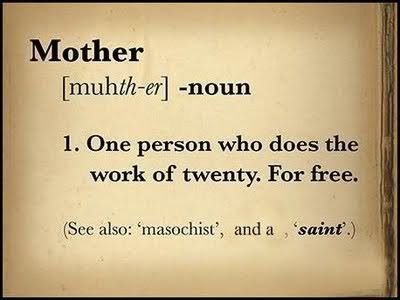
I saw this image posted the other day on the Facebook page
of a
social networking site for mothers. When I last checked a moment ago, the
picture had been shared 2,920 times (including by a friend of mine, whose status
update is where I first saw it) and “liked” 3,742 times on this mothers’ site page
alone.
I didn’t share the post. I did not “like” it. I didn’t even like it.
Which made me more or less alone among the 700-some people who
left comments. I haven’t read every last one, but in a quick skim I didn't see any other commenter who wasn’t delighted with the sentiment expressed
in the post. Typical comments—short and hastily typed, as if clicked out
between laundry loads, or while waiting that cry from the nursery signaling naptime had ended—said things like “True!” and “Sharing,” and
“Ain’t this the truth,” and “AMEN,” and “Sounds
about right” and “Us mums are incredible :)” and “LOVE LOVE LOVE this.”
Not to be a buzz kill. But this approving reaction goes a long way
toward explaining why mothers’ labor gets exploited, why mothers, far from
being financially compensated for their parenting work, are in fact financially
penalized for performing it, to their eventual economic peril.
Oh, that's OK, the comments suggest. We don’t mind! Our children are so important to us. We’re happy to do
it! We LOVE LOVE LOVE doing it!
Lots of people love their work. Yet many of them are nevertheless rewarded for it monetarily, sometimes handsomely. (At least writers, who also often wind up working for free because the market exploits their love of the work, complain about it.) Posts like this—simply the new-technology delivery of an age-old sentiment—are one way society reinforces the idea that good mothers don't mind sacrificing. That good mothers are proud of sacrificing.
Lots of people love their work. Yet many of them are nevertheless rewarded for it monetarily, sometimes handsomely. (At least writers, who also often wind up working for free because the market exploits their love of the work, complain about it.) Posts like this—simply the new-technology delivery of an age-old sentiment—are one way society reinforces the idea that good mothers don't mind sacrificing. That good mothers are proud of sacrificing.
The post isn’t quite accurate; even the most hardworking mothers don’t do
the work of more than two or three people, tops. And not even that on average, according to a
cover story in Time magazine in August, which reported that new research shows mothers
work about the same amount as fathers—as long as you count both paid and non-paid work, since mothers unsurprisingly do proportionately more of the latter than fathers do.
“ What these new findings mean is that the widespread belief
that working mothers have it the worst—a belief that engenders an enormous
amount of conflict between spouses—is simply not the open-and-shut case it
once was,” wrote Ruth Davis Konigsberg. “… And it's time that women — myself
included — admit it and move on.”
Again, I must differ. Unless by “move on” Konigsberg means “turn
our attention from who works more hours
to focus on what is really the far bigger issue—i.e., the fact that many more of those oh-so-equal hours that fathers
put in are rewarded with paychecks. Not to mention retirement accounts, professional
advancement, earning power, social status, health and dental, the respect of future employers and the occasional company car.”
Whereas mothers, as even the disliked post above correctly
notes, “work for free” much of the time.
Konigsberg doesn’t dwell on the pay thing. On the contrary, she
barely mentions it, writing as if the issue of monetary compensation were a triviality, as if paid
and unpaid work were, for all practical purposes, the same thing; work is work.
I, on the other hand, consider a paycheck a salient difference, if for no other reason because even when it's shared between partners, the partner whose name is on the checks is building a much stronger foundation of future employability.
I, on the other hand, consider a paycheck a salient difference, if for no other reason because even when it's shared between partners, the partner whose name is on the checks is building a much stronger foundation of future employability.
Frustrating as it is to see that overlooked in a Time cover story, it's better than the other, far more widespread
attitude: that paid and unpaid work are completely
different. So different, in fact, that unpaid work actually isn’t work at all.
Mothers’ caregiving work doesn’t count for the
purpose of acquiring health insurance or 401(k) contributions or Social
Security credit. Mothers’ work doesn’t count even if their labor—washing
diapers, meeting with teachers, driving to dental appointments, coaching with
homework, preparing meals—frees the other parent to devote more
time to work that does earn a
paycheck and therefore does count. (To
avoid being labeled sexist, let me note that
the genders are occasionally reversed.)
Sure, by now anybody with a speck of cultural sensitivity
is careful to use the PC terminology, to delicately distinguish between
work “outside the home” and “in the home.” But that's one of the rare times when mothers’ caregiving
work is treated like, well, work.
Mothers who “opt out” to care for their children
are considered to have stopped working. If
they later try to find a paid job, they worry about how to explain “the gap in their
resume” as if having to rationalize a time when they weren’t working. I have talked to women who've been told they would be better off padding that gap with a minimum-wage, part-time, unskilled job than admitting to potential employers that they were at-home mothers.
This attitude helps explain why, even when they're getting paid and working in comparable jobs, mothers make less money than non-mothers (including fathers and childless people of either sex). It helps explain why more women than men are poor. It helps explain why so little status is attached to mothering, why at-home mothers often mention experiencing the “cocktail party demotion” in which they see people’s eyes, when they mention their occupation, dart around the room in search of better conversation, as if a (working) accountant or engineer is automatically better at exchanging sparkling repartee over the martinis.
This attitude helps explain why, even when they're getting paid and working in comparable jobs, mothers make less money than non-mothers (including fathers and childless people of either sex). It helps explain why more women than men are poor. It helps explain why so little status is attached to mothering, why at-home mothers often mention experiencing the “cocktail party demotion” in which they see people’s eyes, when they mention their occupation, dart around the room in search of better conversation, as if a (working) accountant or engineer is automatically better at exchanging sparkling repartee over the martinis.
It helps explain why, when I divorced and thereby lost my
health insurance, I wasn’t eligible for the federal government program that,
because of the bad economy, subsidized about two thirds of COBRA premiums for laid-off
workers. Even though it was just as tough for me to find a job or afford COBRA (about
$500 a month, in my case).
I may not have been doing the work of twenty people. But in the federal government's eyes, I wasn't even doing the work of one.
So am I suggesting that someone should start paying mothers a salary for taking care of their own children? Well, that's hard to envision, certainly in the current political climate. But folks, let's start considering it real work that deserves the respect and some of the economic protections and social benefits we give to other kinds of work. Either that, or let's insist that mothers and fathers share the work of parenting more equitably—that both, let's say, do the work of ten people.
Until then, damned if I'm going to “like” a post comparing me to a masochist and a saint. I have no interest in earning either label.
So am I suggesting that someone should start paying mothers a salary for taking care of their own children? Well, that's hard to envision, certainly in the current political climate. But folks, let's start considering it real work that deserves the respect and some of the economic protections and social benefits we give to other kinds of work. Either that, or let's insist that mothers and fathers share the work of parenting more equitably—that both, let's say, do the work of ten people.
Until then, damned if I'm going to “like” a post comparing me to a masochist and a saint. I have no interest in earning either label.
Here’s what I wrote in the comments:
True or not, celebrating this sort of slogan reinforces the idea that it's OK. Mothers should not be expected to do the work of 20 people for free. The work of raising children should be shared among fathers and the rest of the village, and mothers should not have to sacrifice their financial security to see that it gets done.
Four people clicked “like” on my comment.
Then the posted comments returned to “True!” and “Awesome!” and
“Yup, spot on."


