Showing posts with label caregiving. Show all posts

Saturday, April 14, 2012

Eleven ways of looking at Ann Romney


I’m not going to write a huge amount (UPDATE: I'm going to write more than 1,200 words, so actually that's quite a lot) about Ann Romneygate, because every publication on earth has already covered it with not one but multiple stories apiece. I’ve currently got five on my screen in tabs. I’m already way oversaturated myself with what is essentially a minor kerfuffle, and not particularly eager to add to the glut.

Still, this kerfuffle does center around one of my main issues: how caregiving work is categorized. I’d feel remiss not to address it at all. And I have thoughts about both sides, albeit somewhat contradictory ones.
 
1.)    I call it Ann Romneygate because Ann Romney, in this metaphor, is the hotel where the break-in occurred, not the G. Gordon Liddy of the episode. Liddy, the original Watergate scandal's villainous protagonist, would in this case be Hilary Rosen, a political professional who remarked that Ann Romney had "never worked a day in her life." Just as the Watergate break-in could theoretically have occurred in any hotel (though thankfully it didn’t, because “gate” is much catchier suffix for subsequent scandals than “Holiday Inn Express”), this isn’t really about Ann Romney per se. It’s about rich ladies who can afford to stay home with their children without worrying in the least about the financial consequences (even, most likely, long term, in the case of divorce or widowhood), and who have the resources to hire out any or all child-care tasks, as they choose.

 2.)    There’s no question that Hilary Rosen’s comment was inaccurate. Of course Ann Romney has worked a day in her life. Many days. Call me naive, but I'll bet that nobody on earth, no matter how privileged or protected, reaches age 63 (as of Ann Romney's birthday on Monday) without doing any work whatsoever, not just single but, cumulatively, multiple days’ worth. Let alone a mother of five. Even if it’s just interviewing potential servants. So Rosen was wrong, not to mention impolitic. Hey political professionals, rather than having to pick apart every sentence before you utter it—and, when you fail to perform this task successfully, having your offhand remarks become three-news-cycle blunders and targets of national ridicule—wouldn’t it be easier just to stop making rude remarks? Yes, even about people with whom you disagree politically?
 
3.)    Sure, I’d like to have caregiving work recognized as, you know, work. So when someone dismissively calls it “not work,” I am obliged to be miffed. People are constantly confusing “doing work that doesn’t bring a paycheck” with “not doing work,” and I’ll take any opportunity to point out that child care does, indeed, entail actual work. Not the hardest work in the world, I'm the first to admit, probably not even as hard most days as being president or running a company, but work nonetheless. You’d think any parent could attest to this. Still, the myth endures.

4.)    On the other hand, I’ve probably said something similar at some point. That’s because in everyday speech, “work” is convenient shorthand for “work outside the home,” “work for pay,” etc. I can understand how the verbal slip occurred. I see what Rosen said as less a damning revelation of disrespect for all mothers than a minor faux-pas (or, at most, a damning revelation of disrespect for Ann Romney).
 
5.)    And let’s not even get into the situation that inspired Rosen’s ill-considered comment in the first place. She was reacting to the news that Mitt, apparently, sends his wife out to find out what is on the minds of that mysterious special-interest group called “women.” Naturally, Mitt can be expected to understand only what regular voters—i.e., men—have on their minds.  ... Where would I start with this?

6.)    I resent Rosen, both Romneys, and the entire mass media for turning this into yet another situation where people opine that only the most privileged women can “afford” to stay home, anyway. Media proessionals are forever indignantly asserting that this is a choice available only to women occupying a narrow stratospheric strata of the socioeconomic tier. First of all, Census studies show that stay-at-home mothers as a group are actually poorer and less well educated than mothers as a whole (many of them, of course, may not have made deliberate choices to opt out of the workforce, but they are working at home). More to the point, I know plenty of stay-at-home mothers of the middle class, women who choose to be with their children even though they have to pinch pennies to do it but also, at the same time, even though they would qualify for good jobs if so chose. You’d think such women were invisible, yet not so far in the past they used to be known to the media and referred to (albeit patronizingly and one-dimensionally) as soccer moms.

7.)    I’m a Democrat. But I’m pretty sure I’d say the same thing if the parties were reversed.


 8.)    All that said, it’s important to note that the experiences of a stay-at-home mother who possesses, for all practical purposes, unlimited financial resources are inevitably going to be drastically different from those of a stay-at-home mother who can’t afford to hire out work. To pretend that insulting Ann Romney in a work-related way is the equivalent of insulting all mothers at every income level in the exact same way is disingenuous in the extreme. Sure, even if you’re Ann Romney, you still have to figure out how to balance a busy schedule (which Ann Romney undoubtedly has) and time with your children, which can be a struggle, emotionally and practically, at any level of wealth. But what you’re not doing, if you’re Ann Romney, or what at least you would not have to do, is the labor that typically comprises at least of half caregiving work. The drudgery. You’re not wiping the spilled mac ’n’ cheese off the floor with a paper towel. You’re not dashing to the basement to throw in a load of laundry at naptime. You’re not running to the supermarket midweek because you’re out of milk and lunch meat, taking the kids with you because there’s no one else to watch them, plunking them in one of those giant fire-engine carts and hoping like hell that the plastic emergency-vehicle inexact replication will keep them entertained long enough for you to grab those items before they start hitting each other or creating chaos in the checkout line. If you’re Ann Romney, you don’t do any of those things. Or I would guess you don’t, anyway—remember, we’re really talking generic rich lady here, as I have no idea what Ann Romney’s actual day-to-day life is like; for all I know she loves pushing a wire cart full of squabbling toddlers through a crowd of frowning onlookers, so always insists on taking care of those midweek runs herself. My point is, she doesn’t have to do those things—or anything else—if she doesn’t want to.

9.)    I debated No. 8 pretty intensely with a friend. For what it’s worth, my friend does not have children. Her income, she says, is just the amount she would pick if she could have her pick of incomes (though this, as an addendum to saying she would not want to be super-rich). My friend argued that it’s not as easy to hire servants as I might think. And that there no longer exists a Downton Abbey-style servant class from which to hire. My counterarguments were a) Oh, boo hoo b) I admittedly don’t know that much about life in the Romnesphere, but I bet that, given 8 percent unemployment, it’s not impossible to find qualified people who are willing to hang out in a luxurious mansion all day doing easy-ish tasks for what must be at least semi-decent pay (because at some point their salaries will probably come under scrutiny). Heck, I know ordinary upper-middle-class people in Minneapolis—affluent, but still within the 99 percent—whose lives are made easier by nannies and the like. Notice I say easier. Probably rarely downright easy.
   
10.)    My friend pointed out that Ann Romney has health problems, which make everything harder. No argument here—I’d take almost anything, including poverty, over poor health. Still, according to Wikipedia, Ann Romney’s MS does not much limit her lifestyle, and she’s been cancer-free since a lumpectomy in 2008.
 
11.)    Verdict: Umbrage in a teapot.


Wednesday, November 2, 2011

A woman's shadow work is never done


Speaking of paid and unpaid work, the New York Times just ran a fascinating op-ed piece by Craig Lambert, deputy editor of Harvard Magazine, about “shadow work.” That’s a term Lambert says was coined 30 years ago by Australian philosopher Ivan Illich to describe all of the work people do that they don’t get paid for, such as housework, shopping, paying bills, etc.


Lambert argues that machines, instead of liberating us from repetitive and menial tasks, have actually increased the amount of shadow work we do. We pump our own gas, squeegee our own windows, bag our own groceries, plan and book our own travel arrangements. Chores that we now perform for ourselves, often with the help of technology, were once done by human beings who got paid for it. At our jobs, support staff  like secretaries and clerks have been reduced, their tasks—typing, copying, mailing, sorting email—added to remaining employees’ other responsibilities. “Even those in senior management perform these humdrum jobs,” Lambert writes.


Doctors say patients complain of fatigue, Lambert notes. “Much of this fatigue may result from the steady, surreptitious accumulation of shadow work in modern life,” he writes. “People are simply doing a huge number of tasks that were once done for them by others.”


I’ll leave it to economists to figure out whether Lambert is right, whether technology has produced a net increase or decrease in shadow work. Obviously, technology has streamlined many unpaid tasks: washing dishes, looking up information, shopping for certain items.


What most interests me is the timely point tucked within Lambert’s piece. More people are questioning, thanks in part to the Occupy Wall Street movement, why so many Americans are struggling while a tiny minority rakes in phenomenal wealth.

Lambert’s thesis provides one explanation for that phenomenon. But he steers around that point, blaming not CEOs but the machines themselves. “The robots have won,” he announces. “The robots are in charge now, pushing a thousand routine tasks onto each of our backs.”


But of course, robots aren’t the ones forcing humans to do extra work. Robots, who will gladly work for free, don’t benefit from the arrangement. Robots aren’t lighting cigars with $100 bills. That would be, at least theoretically, the people who profit from the robots’ work. Of course, not all business owners are thriving financially, not even those who have replaced employees with machines. But whatever financial savings are being seen—in salaries, health insurance and so on—isn’t going to the machines, let alone the people taking on extra shadow work.


Meanwhile, there’s one important category of shadow work that Lambert doesn’t mention at all—understandably, since it’s not central to his point—but that is relevant to this blog: caregiving. Technology, as far as I can tell, neither dramatically reduces nor increases the work of caring for children, the old and the sick. But some research indicates that parents, especially mothers, are spending more time than ever on childcare.


As the New York Times reported last year:

Before 1995, mothers spent an average of about 12 hours a week attending to the needs of their children. By 2007, that number had risen to 21.2 hours a week for college-educated women and 15.9 hours for those with less education.

Although mothers still do most of the parenting, fathers also registered striking gains: to 9.6 hours a week for college-educated men, more than double the pre-1995 rate of 4.5 hours; and to 6.8 hours for other men, up from 3.7, according to an additional analysis by Betsey Stevenson and Dan Sacks, economists at the Wharton School of the University of Pennsylvania.


It stands to reason that, as our population ages, we’ll be spending more time caring for our elders, too.

Unpaid caregiving represents a big chunk of shadow work, and it still falls disproportionately on women. If Lambert is right, it helps explain why we’re feeling so overwhelmed. We’re juggling paid work, plus more of the traditional shadow work than we performed in the past, plus new high-tech forms of shadow work.

Now, if you’ll excuse me, I have some shadow work to do in the kitchen.


Friday, October 28, 2011

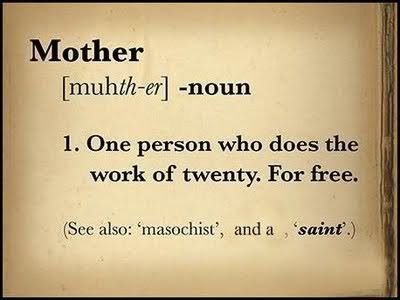
Why I don't "like" the idea that mothers do the work of twenty, for free


I saw this image posted the other day on the Facebook page of a social networking site for mothers. When I last checked a moment ago, the picture had been shared 2,920 times (including by a friend of mine, whose status update is where I first saw it) and “liked” 3,742 times on this mothers’ site page alone.

I didn’t share the post. I did not “like” it. I didn’t even like it.

Which made me more or less alone among the 700-some people who left comments. I haven’t read every last one, but in a quick skim I didn't see any other commenter who wasn’t delighted with the sentiment expressed in the post. Typical comments—short and hastily typed, as if clicked out between laundry loads, or while waiting that cry from the nursery signaling naptime had ended—said things like “True!” and “Sharing,” and  “Ain’t this the truth,” and “AMEN,” and “Sounds about right” and “Us mums are incredible :)” and “LOVE LOVE LOVE this.”

Not to be a buzz kill. But this approving reaction goes a long way toward explaining why mothers’ labor gets exploited, why mothers, far from being financially compensated for their parenting work, are in fact financially penalized for performing it, to their eventual economic peril.

Oh, that's OK, the comments suggest. We don’t mind! Our children are so important to us. We’re happy to do it! We LOVE LOVE LOVE doing it!


Lots of people love their work. Yet many of them are nevertheless rewarded for it monetarily, sometimes handsomely. (At least writers, who also often wind up working for free because the market exploits their love of the work, complain about it.) Posts like this—simply the new-technology delivery of an age-old sentiment—are one way society reinforces the idea that good mothers don't mind sacrificing. That good mothers are proud of sacrificing.
The post isn’t quite accurate; even the most hardworking mothers don’t do the work of more than two or three people, tops. And not even that on average, according to a cover story in Time magazine in August, which reported that new research shows mothers work about the same amount as fathers—as long as you count both paid and non-paid work, since mothers unsurprisingly do proportionately more of the latter than fathers do.

“ What these new findings mean is that the widespread belief that working mothers have it the worst—a belief that engenders an enormous amount of conflict between spouses—is simply not the open-and-shut case it once was,” wrote Ruth Davis Konigsberg. “… And it's time that women — myself included — admit it and move on.”

Again, I must differ. Unless by “move on” Konigsberg means “turn our attention from who works more hours to focus on what is really the far bigger issue—i.e., the fact that many more of those oh-so-equal hours that fathers put in are rewarded with paychecks. Not to mention retirement accounts, professional advancement, earning power, social status, health and dental, the respect of future employers and the occasional company car.”

Whereas mothers, as even the disliked post above correctly notes, work for free much of the time.

Konigsberg doesn’t dwell on the pay thing. On the contrary, she barely mentions it, writing as if the issue of monetary compensation were a triviality, as if paid and unpaid work were, for all practical purposes, the same thing; work is work.

I, on the other hand, consider a paycheck a salient difference, if for no other reason because even when it's shared between partners, the partner whose name is on the checks is building a much stronger foundation of future employability.
Frustrating as it is to see that overlooked in a Time cover story, it's better than the other, far more widespread attitude: that paid and unpaid work are completely different. So different, in fact, that unpaid work actually isn’t work at all.

Mothers’ caregiving work doesn’t count for the purpose of acquiring health insurance or 401(k) contributions or Social Security credit. Mothers’ work doesn’t count even if their labor—washing diapers, meeting with teachers, driving to dental appointments, coaching with homework, preparing meals—frees the other parent to devote more time to work that does earn a paycheck and therefore does count. (To avoid being labeled sexist, let me note that the genders are occasionally reversed.)

Sure, by now anybody with a speck of cultural sensitivity is careful to use the PC terminology, to delicately distinguish between work “outside the home” and “in the home.” But that's one of the rare times when mothers’ caregiving work is treated like, well, work.

Mothers who “opt out” to care for their children are considered to have stopped working. If they later try to find a paid job, they worry about how to explain “the gap in their resume” as if having to rationalize a time when they weren’t working. I have talked to women who've been told they would be better off padding that gap with a minimum-wage, part-time, unskilled job than admitting to potential employers that they were at-home mothers.

This attitude helps explain why, even when they're getting paid and working in comparable jobs, mothers make less money than non-mothers (including fathers and childless people of either sex). It helps explain why more women than men are poor. It helps explain why so little status is attached to mothering, why at-home mothers often mention experiencing the “cocktail party demotion” in which they see people’s eyes, when they mention their occupation, dart around the room in search of better conversation, as if a (working) accountant or engineer is automatically better at exchanging sparkling repartee over the martinis.

It helps explain why, when I divorced and thereby lost my health insurance, I wasn’t eligible for the federal government program that, because of the bad economy, subsidized about two thirds of COBRA premiums for laid-off workers. Even though it was just as tough for me to find a job or afford COBRA (about $500 a month, in my case).

I may not have been doing the work of twenty people. But in the federal government's eyes, I wasn't even doing the work of one.

So am I suggesting that someone should start paying mothers a salary for taking care of their own children? Well, that's hard to envision, certainly in the current political climate. But folks, let's start considering it real work that deserves the respect and some of the economic protections and social benefits we give to other kinds of work. Either that, or let's insist that mothers and fathers share the work of parenting more equitablythat both, let's say, do the work of ten people.

Until then, damned if I'm going to “like” a post comparing me to a masochist and a saint. I have no interest in earning either label.

Here’s what I wrote in the comments:

True or not, celebrating this sort of slogan reinforces the idea that it's OK. Mothers should not be expected to do the work of 20 people for free. The work of raising children should be shared among fathers and the rest of the village, and mothers should not have to sacrifice their financial security to see that it gets done.

Four people clicked “like” on my comment.

Then the posted comments returned to “True!” and “Awesome!” and “Yup, spot on."