Friday, April 15, 2011

Male researcher: Women who post Facebook pictures could be appearance-obsessed, attention-starved, competitive sluts

You know that scene at the beginning of “The Social Network,” where the fictionalized Mark Zuckerberg gets in a fight with his fictionalized girlfriend in a bar, then storms home and gets revenge by inventing a “hot or not”-type site that includes his (now ex-) girlfriend’s picture?

Reading about this study made me wonder if its lead researcher had been in a fight in a bar with an ex-girlfriend who likes to post Facebook photos of herself.

Women who post numerous pictures of themselves and have lots of friends on Facebook aren't just sociable, or proud of their photos—they’re actually kind of messed up, according to the study, which was conducted at State University of New York at Buffalo, reported in the journal Cyberpsychology, Behavior and Social Networking, described here in a university press release and publicized in the Los Angeles Times and elsewhere. In fact, the researchers seem to have concluded, it’s not just prolific picture posters but all women whose Facebook habits reveal identity and security issues.
[R]esearcher Michael A. Stefanone, PhD, and colleagues found that females who base their self worth on their appearance tend to share more photos online and maintain larger networks on online social networking sites.
He says the results suggest that females identify more strongly with their image and appearance, and use Facebook as a platform to compete for attention.
… Among other things, the team looked at the amount of time subjects spent managing profiles, the number of photos they shared, the size of their online networks and how promiscuous they were in terms of "friending" behavior.
Dr. Michael A. Stefanone finds women's Facebook habits "disappointing."
Thwarted romantic obsession might plausibly explain why, although half his subjects were men, Dr. Stefanone, an assistant professor of communications, hardly even mentions men except by implied favorable comparison to “females.” It might also explain the choice of the word “promiscuous,” which of course is Latin for “slutty,” to describe someone with lots of FB friends (though, to be fair—since the whole study isn’t available online without a subscription—there’s no way to know whether that word originated with Stefanone or the author of the press release). And surely post-rejection bitterness might shed light on why a researcher, examining what most people consider an innocuous, everyday activity—posting pictures of oneself on a site that, um, offers a popular tool with which users post pictures of themselves—interprets it so skeptically, at least when engaged in by women, as both a symptom of misplaced values and self-esteem and a calculating ploy to “compete for attention.”

Actually, up to a point I’m willing to go along with Stefanone’s ideas. I’m as interested in subtle sociological patterns as the next lifestyle journalist who took a few sociology classes in college, and I think studying the way people behave on Facebook—an novel communication medium now entrenched in the daily lives of millions—is worthwhile. I’m sure the lab coats could draw all kinds of fascinating conclusions about our innermost thoughts based on people’s Facebook habits, their status updates, their tendency to clutter up your newsfeed with their Farmville activity.

But … come on.

Not that my own FB experiences are empirical evidence of anything, but most of my friends who post lots of pictures of themselves strike me as people who like taking pictures and who do things like travel or get together with friends, activities they believe (rightly or wrongly) are of interest to others. Some of these Facebook photo posters are—get this—men. (“So if a man posts a lot of pictures on Facebook, does it mean he’s a woman?” asked one online commenter.)
No argument here with at least one of Stefanone’s findings, that women in our culture are concerned about their appearance. But that hardly requires extensive personality testing of Facebook users. It could be more easily demonstrated by, say, flipping through pretty much any random magazine this side of  Cyberpsychology, Behavior and Social Networking (and maybe that as well; again, I don’t have a subscription, so I have no way of knowing if it typically features weight-loss and makeup articles and photos of celebrities in bikinis).

Still, even if Stefanone and I agree on the phenomenon’s existence, I recoil at his description of it:
 “Although it's stereotypical and might have been predicted," he says, "it is disappointing to me that in the year 2011 so many young women continue to assert their self worth via their physical appearance -- in this case, by posting photos of themselves on Facebook as a form of advertisement. Perhaps this reflects the distorted value pegged to women's looks throughout the popular culture and in reality programming from 'The Bachelor' to 'Keeping Up with the Kardashians.'”
Perhaps?? I would think it obvious to anyone from the Kardashians to Naomi Wolf that cultural influences play a role here. Otherwise, why would it matter that the year is 2011? Implied in Stefanone’s quote is the assumption that, due to recent cultural changes, women should be over all this appearance-related “advertisement” bullshit by now. (Speaking of advertisements and women’s appearance, here is a great story and slideshow illustrating one important way cultural influence on women's appearance-consciousness has been and still is leveraged and how, as is so often the case, it’s tied to corporate profits.)

If cultural influences didn’t play a role, if instead every woman in Stefanone’s study were spontaneously and independently driven to act in this "disappointing" (at least, to Stefanone) way without having received any external cues … then we are left with either the also quite viable possibility that young human females are biologically driven to employ visual signals in their mating behavior (in which case it wouldn't much matter if it were 2011 or 500,000 B.C.) or we’re all living in an M. Night Shyamalan movie.

By the way, I became curious about what Michael A. Stefanone has posted on his own Facebook page, so I—promiscuous Facebook slut that I am—sent him a friend request. He accepted it right away, no questions asked. That is, whereas I was somewhat familiar with the person to whom I was extending an offer of friendship, he readily friended a total stranger. Wonder what conclusions about male behavior we can draw from that.

For the record, Stefanone has 8% fewer friends than me. He also has fewer photos.

However, of the 38 photos I’ve posted, I’m in seven. Stefanone has only 16 photos, but he’s in 13 of them.

Sunday, April 10, 2011

Good news on the job front


I know it’s lame to start a post with an apology and/or excuse for going so long without posting, but here goes: Sorry I’ve gone so long without posting. I’ve been busy.

The good news is that I’ve been busy … with work!

Those of you who saw my essay “Regrets of a stay-at-home mom” on Salon or one of the other places it appeared or was discussed will know what a welcome turn of events this is. As I wrote in that essay, which is about the financial risks parents take when they give up work to care for children, I mentioned that since 2008, when I got divorced and moved back to Mineapolis, I had sent out countless resumes resulting in but a tiny handful of interviews, that I’d been passed over for jobs I wouldn’t have considered in my 20s, that I’d tried but failed to land jobs that would have paid $20,000 lower my last full-time salary, 15 years ago.

How things can change in a few months—a few months in which, not coincidentally, a Salon essay about your miserable job prospects and pathetic finances goes slightly viral, gets passed around by friends, so it gets noticed by editors at your local paper as well as reprinted on its Sunday op-ed section, the local paper being the workplace out of all local workplaces for which your job skills happen to be most ideally suited.

That’s how I came to be hired as a writer for the niche products department of the Star Tribune, my local paper in Minneapolis, where I started work last week.


What are niche products, you’re probably wondering. They’re the special sections the paper puts out now and then throughout the year, on subjects such as aging, health and wellness, autos, back-to-school preparations. These sections were created, originally, as vehicles for advertising. At one time they contained nothing but advertising. Gradually they evolved, first acquiring bland filler and then better freelance-written pieces. A few months ago, the newspaper made them part of the editorial department, with an editor and now, a writer. Me.

It’s a wonderful job in so many ways. The work, I think, is going to be fun—we’re inventing from the ground up a product for which the bar, historically, has been set low. That lends the enterprise a giddily freeing sort of creativity. How good can we make these things? It’s entirely up to us!

Frankly, as someone who has foot-tall stacks of unread magazines in at least three rooms of my house, 60 books in my Amazon shopping cart (that’s not even counting the ones I’ve already purchased, but not yet read), 23 tabs currently open on my computer screen (which is less than usual, actually), a dining room table covered with newspapers and other assorted pieces of paper with words on them, I have no interest in foisting additional writing on the world unless I can make it as worth reading as possible. That’s the fun challenge of the job.

Also, the job is part time, a great way to segue back into the workforce. I can schedule my 25 hours a week just about whenever I’d like (“The only thing I can tell you for sure is that you can’t do them all in one day,” said my easygoing editor), which makes my work-family balance relatively easy to maintain (and by “easy” I mean “impossible,” though by "relatively," I mean "slightly less impossible than if I worked a rigid full-time schedule"). And I can fill my so-called “free time” with freelance assignments and personal projects like essays, a memoir and, er, blogging.

Put it this way: If this job had been available 15 years ago, I might never have given up a steady paycheck for freelancing in the first place.

Oh, there are a few downsides. Salaries in the niche products area are capped about midway up the guild scale—to keep the products competitive with similar publications—so although my hourly wage is actually a bit higher than it was 15 years ago (and much higher than the wage offered by literally all of would-be employers who ultimately rejected me), my paycheck will still be smaller than if I worked, as I used to, as a regular newspaper reporter. Because I’m part time, I don’t get health insurance, so for now I’m stuck continuing to throw away $200 a month for a private policy with a deductible so high that the only way I’ll ever receive benefits is if something terrible happens to me. And although writing for sections designed to be profitable seems to me a perfectly valid strategy for practicing journalism in the face of the industry’s current business-model crisis, you can probably guess that mine is not the highest status job in the newsroom. I may not win a Pulitzer anytime soon, and don’t look for my picture on the side of a bus.

But so what? It’s a better job than all of the jobs I interviewed for, better than most of the jobs I sent resumes to, better than most of the jobs in the entire world, for that matter. In fact, for me right now—and, as I say this, I’m knocking furiously on the laminated particleboard or whatever it is my desk is made of—this job feels ludicrously perfect.

Tuesday, March 22, 2011

An open letter about scolding mothers

About all I know about Kelly Oxford is that she's funny, Canadian, and says funny things on Twitter. I'm not sure how I wound up following her. but I'm glad I do.

She's foul mouthed and brash and sometimes unkind ("How old were you when you realized Robin Williams wasn't funny?"—probably around 35, I think—and "Weird that as an adult, all the emotion I'm hearing in Madonna's 'Crazy For You' is Madonna hoping she hits all the notes and can hold them.") and she makes me laugh ("Your kid’s ready to come out of diapers when she yells, 'Hey, guys I’ll be down soon, I just need to get Mom to change my diaper' Right?"), often because many of her tweets hold both humor and a grain of truth ("Anyone who says 'I'm a bitch before I get my coffee' is a bitch after they get their coffee too.").

Oxford tweets things that "nice women" don't often say and that "nice mothers" hardly ever do, though she has small children ("Older 2 kids better sharpen up because the 2yr old yelled, "YOU GO GIRL!!" to her Dad in this restaurant and now she's my favorite.").

Kelly Oxford

I suppose anyone who dabbles that close to the edge of decorum gets a lot of complaints. A few days ago, apparently, she got some when she made a joke about, of all things, Victoria Beckham's thinness. On her blog, Oxford writes an open letter to this complainer:
Yesterday I tweeted something like, “I wonder how many waiters served a pregnant Victoria Beckham and think to themselves ‘Eating for one are we?’”
But I erased it because it was brought to my attention that Joan Rivers already said “Congratulations to Victoria Beckham, who’s pregnant with her fourth child! She’s finally eating for one.”
You then sent me many, many messages on Twitter which said, and I paraphrase:
This isn’t funny. I hope your children grow up with a good sense of body image. What you say and do as a parent is what your children learn
Oxford proceeds to shred the complainer's argument, making a lot of good points, most not directly applicable to the experiences of those of us who don't regularly crack celebrity jokes to our 100,000+ Tweeps.

But a few apply to my own life, and maybe yours if you've ever received (or issued!) criticisms, snap judgments, and faultfinding about your (or someone else's) mothering or life choices. I wrote about this once, and wish I'd included lines like these:
 You are the reason that mothers feel as though they cannot be themselves. Why women who aren’t mothers question their ability to raise a child and fear losing themselves
Oh, and this part is relevant, too, if any of those criticisms you've heard involve your kid having "an ounce of personality" (or a pound, or a ton):
... That any ounce of personality must be squashed in order to raise ‘good’ and ‘proper’ and ‘kind’ children. That’s bullshit.

Thursday, March 17, 2011

Toxic comments on the "mommy" essay

Yikes. I just got through skimming the comments on the WSJ essay I extolled in my last post.  With the exception of a few shining jewels of polite or even enthusiastic agreement, they are overwhelmingly critical and in many cases downright nasty.

Which, God knows, is not atypical in anonymous internet comments, especially in connection with articles about child-rearing or motherhood (more on that in a moment). Anyway, after reading them I was moved to dwell on this issue yet again to point out three things:

1.) Approximately half of the comment posters missed the essay's point entirely. They seemed to think Brodesser-Akner was complaining about her children calling her "mommy." Which I thought she made clear was not the problem. Her complaint involved the frequent use of the word by other adults to describe her, themselves, mothers in general, or any activity (blogging, working part time, bickering about work-family balance) in which mothers are, or supposedly are, involved.

2.) Those who, after reading an article, are going to take the extra time to log onto the site, compose a comment, and then post it, probably should not have the comment read, "This article was a waste of time." Why not waste a little less time by not adding a comment which is yet another waste of time?

3.) I can understand why, to many people, it may seem no big deal whether a woman with children is referred to (stressing again that we're talking by people other than her kids) as mommy, mother, mom, mama, ma, female parental unit, person of maternity or member of the child-rearing community. And sure, compared to, say, what’s happening in Japan, it isn't. But then, neither is probably 99.999 (add a bunch more 9s) of what's on the internet and only a slightly smaller proportion of what's reported in the WSJ, or any publication.

Still, the words we use to describe things actually are important. Media depictions of people and their roles are important. Those things shape our culture and influence the way we view each other and our contributions to society. Try this experiment: Say you're an employer, evaluating two comparable candidates for an important position. Both of their resumes indicate they're currently not in the paid workforce. In the interviews, you ask each what she's been doing. One says, "I work at home, caring for my children." The other says, "I'm a mommy."

All other things being equal, which one are you going to hire?

As I said in my last post, women's roles in business and politics have changed dramatically over just a couple of generations. Women's roles as mothers still lag behind. Mothers pay a wage penalty in the workplace compared to non-mothers with comparable jobs and backgrounds (including women without children and men either with or without children). Women still do the bulk of childcare and housework. As a culture, we're trying to figure out how to reconcile these things, still trying to work out the bugs. That's a big deal, and as we go through that process, the issue of what words we use, along with any number of other details, is indeed important enough to write about.

Dismissing mothers' concerns as "whining" or "overwrought" or "a waste of time" or "silly" or "trivial" or "yeah, yeah, we get it already" is incredibly common—even among people who are otherwise sympathetic to feminist concerns—for reasons I am still trying to understand. I hope to write about this, too, someday, because writing about something is often the best way to make sense of it. (If anyone can suggest a way to, say, google "whining" and determine how often words like those are used to apply to mothers compared to everyone else, I would greatly appreciate it.)

In the meantime, if we want people to take mothers' issues seriously, it doesn't help to refer to them as mommies' issues.


Wednesday, March 16, 2011

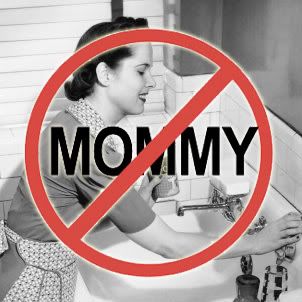
Let's give "mommy" a rest

There's probably a German word for this: the experience of reading something that precisely expresses some inchoate feelings that have been floating around the edge of your consciousness for a while without your having fully explored them, even though you do intend to do so at some point and maybe write an essay about them, which you now realize is impossible because this other writer has managed to describe said feelings so articulately that even though you're kind of disappointed at the loss of your own essay you go, "Yes! Yes! This!!" and click immediately to your blog to link and post about it. I suggest, Readingfeelingtheregoesyouressaybloggenfreude.

That's the experience I had upon reading Taffy Brodesser-Akner's "Time for a War on Mommy" in the Wall Street Journal's online blogs.

Brodesser-Akner complains about the ubiquitousness of the word “mommy” to describe women with children—especially as a modifier to “track,” “wars,” “blogger,” etc. The label, she argues, does a disservice to everyone involved: to the particular women in question, to mothers in general, and even to their children—who do not, contrary to conventional wisdom, necessarily benefit from growing up under the impression that their maternal parental units’ lives revolve entirely around their existence.

Photo from momlogic.com


Let me just pull a quote or two to give you the gist:

Why are we grown women calling each other Mommy? Is being a mother such a silly avocation that we have to baby it up, stringing it with the hormones and gushy feelings of what our children call us? Does it strike anyone that calling a woman who has had a child Mommy is demeaning and infantilizing? Does it strike anyone that calling philosophical disagreements Mommy Wars is no different than screaming “GIRL FIGHT!” as two strippers go at it in a mud pit?

And

Maybe you think I’m taking this too seriously. But consider this: When we allow our children to name us, a name they use before they can speak, and then we go by that name in the world, are we doing them any favors? When our children see that we are first and foremost a mother, and a mother in their terms, I believe they suffer.

I have long hated the use of the word "mommy" by anyone but my kids (who, sadly, haven't uttered it for at least a decade, and in fact now often upgrade to the crisply mature “Mother”).

As someone who longs to dignify the role of motherhood—to spread the idea that although, yes, we often spend an inordinate portion of our days watching cartoons and managing poop, caring for children is ultimately an important project, one among many important projects in which we are engaged—I find the word “mommy” demeaning and condescending. To me, it sends the message that a being involved with children is silly and trivial and babyish. And so, it implies by extension, am I.

By the way, like Brodesser-Akner, I wrote a Salon essay that ran under a headline with the word “mommy” in it. But in that case, the subject’s mommyishness was the whole point—I was talking about a phenomenon (schmaltzy mass-emails about motherhood) that in itself was demeaning, condescending, trivializing, etc. etc. I was fine with that.

So I disagree with Rachel Larimore who, writing for Slate's XX factor, half agrees with that "mommy" is overused but pooh-poohs Brodesser-Akner's annoyance as overwrought. Larimore skirts the edge of arguing that what words we use to describe things don’t much matter. Which seems a strange position for a writer to take.

“And really, aren’t the terms mommy wars and mommy track largely creations of the media?” Larimore asks. Well, yeah. Is someone who writes a blog for an online politics and culture magazine seriously arguing that if some term’s widespread use is confined mainly to the media then we can safely ignore it, confident that it has zero effect on anybody's actual lives or their perceptions of things?

Larimore also notes that fathers "don’t sit around wringing their hands about it all or devout thousands of column inches to the issue." Right. Maybe that has something to do with stay-at-home mothers outnumbering stay-at-home fathers about 34:1, with even mothers with full-time jobs still doing the lioness’s share of work at home. Maybe it is related to the fact that, although fathers are unquestionably changing more diapers than they did a generation or two ago, in that same time many many many more mothers are working outside the home (sorry, too rushed to look up statistics; might actually be more than three "manys") while still struggling to get their domestic lives to catch up from 1963. In any case, are a few thousand column inches here or there really too much to ask, considering they're analyzing one of the most dramatic social changes of all time?

By the way, I noticed, among the comments, one by a poster named Taffy forlornly asking, “Was my comment removed for a reason?”

I don’t know if that’s THE Taffy, as in Taffy Brodesser-Akner, the author of the WSJ piece. I don't know if Slate actually removed Taffy's comment, or why. But I'd like to let The Taffy know—as well as, really, any Taffy, along with people not named Taffy —that your comments (including, needless to say, comments defending any and all uses of "mommy") are welcome below!

Thursday, March 10, 2011

Vacation? What vacation??

A few of the commenters over on WBUR who heard my "Here and Now" program earlier were a bit put off by my comparing staying home with kids to a luxurious vacation, both on the air and in the accompanying essay.

Frankly, I just don't understand their confusion.

What are you other SAHMs trying to tell me -- that your kids don't feed you grapes and fan you with palm fronds every day while you lounge on the beach watching Oprah and eating bon bons?

Just kidding, of course! Bon bons are much too fattening.

Seriously, I can bring up an image of myself on a typical day at home, especially when my boys were small, standing knee deep in scattered toys, the kids running around yanking curtains off the windows and throwing scrambled eggs on the ceiling between fist fights, me holding an overloaded basket of laundry, looking at a sink full of dirty dishes, my throat hoarse from yelling ...

What, that's not how you like to spend your luxurious vacations?

To clarify. I didn't mean "luxurious vacation" in the sense of, well, luxurious. Or, even, technically, involving vacation. Not as in time away from work, anyway. Because of course, caring for children is hard, hard work. The hardest work I've ever done. Times 10.

(Quick anecdote: I used to be a newspaper reporter. My ex-husband was, and still is, a newspaper reporter. He would come home after I'd had a long, hard day with the kids, and have the nerve to complain about his job. I'd say, "Look. I've done your job. I know it can be hard. But one thing I can say is that I never ended a day of newspaper work with a throat that was sore from yelling.")

(Poor guy just wanted to vent a little at the end of a long day of breadwinning? No wonder he divorced her, some of you are probably thinking.)

Anyway! What I meant was that being with my children every day was filled with the rich experiences that a wonderful vacation can provide, the priceless memories that stay with you for life. And by luxurious I meant expensive. Possibly unaffordable.

It was my way of attempting to explain how I can believe that women probably shouldn't quit their jobs to stay home with their kids, and at the same time not regret that having done so myself. That's a difficult thing to explain, involving two seemingly contradictory statements -- the financial mistake paired with the lack of regret -- and people don't always understand what I'm trying to say.

That's OK. I'll keep trying. That's what we're here for!

Did you stay home with kids? Do you regret the decision, or cherish the time or both? Or, if you continued working, do you have any regrets in the other direction? How do you like to spend your luxurious vacations? Comments on all of the above or any other seemingly contradictory issues are more than welcome!

Welcome, "Here and Now" listeners/website readers!

My interview NPR's "Here and Now" program finally aired today (it had been bumped a couple of times earlier for breaking news in Egypt). If you missed it, you can listen to it here. (Click the button near the top of the page.)

For those of you who are visiting after hearing the broadcast, welcome! This is a good place to discuss work-family balancing, the financial hazards of stay-at-home parenting, pressures on mothers, and other life choices women make and the cultural context in which they make them.

Feel free to suggest topics, or just write your thoughts. Glad to have you here!

P.S. If you like the "Here and Now" segment, you might also enjoy a call-in program I did recently on Minnesota Public Radio with law professor Joan C. Williams, director of the Center for WorkLife Law and author of Reshaping the Work-Family Debate: Why Men and Class Matter. You can hear it here.